
Uncategorized
Bali to Komodo for VIP Delegations: 2026 Protocol Guide
Escorted VIP delegations extend Bali programs to Komodo National Park by flying Denpasar to Labuan Bajo — about an hour…
Aug 25, 2026
9 min read

Police Escort Bali Editorial Desk
Reviewed for accuracy
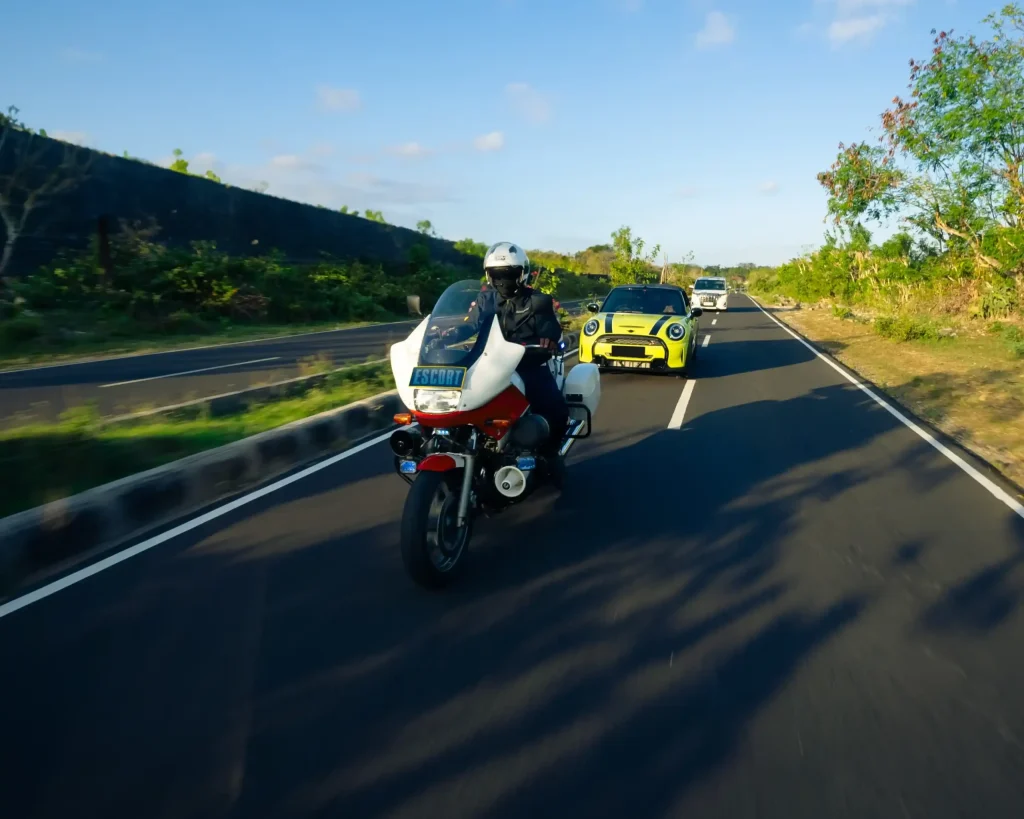
On Bali’s busiest dates the binding constraint is not price — it is availability. Conference weeks, national holiday corridors and Balinese ceremonial periods compress road capacity, vehicle fleets, chauffeur rosters and police assignment capacity at the same time. Escort approval remains a police decision in every case. For peak windows, plan four to eight weeks ahead and keep your timing flexible.
Three separate pools have to line up on the same morning. First, permission: under Law No. 22 of 2009 on Road Traffic and Road Transport, priority use of the road is exercised only after permission is obtained from the police, and under Perkap No. 10 of 2012 the escorting itself is carried out by specially assigned traffic-police personnel. Second, the officers that unit can assign on your date. Third, the civilian side we run ourselves — vehicles, chauffeurs, coordinators, and the hours needed to survey a route properly.
On an ordinary weekday all three are usually obtainable inside a working week. On a peak date they compete with each other, and with every other movement in the same corridor. A larger budget does not resolve that competition. The escort is a police function, granted on the assessment of officers — never automatic, never guaranteed in advance. The figures published on our rates page cover the part we perform: coordination, protocol handling, vehicles, chauffeurs and operational readiness. They are not the price of an officer, and no rate card moves a date that is already full.
Most large programmes sit in Nusa Dua, around BNDCC and the wider ITDC complex. When a significant delegation moves, traffic management measures are applied along its corridor, and everything else is planned around that. Delegate traffic also clusters into the same two hours morning and evening, on the bypass and the Mandara toll road. The airport is roughly 12 km from Nusa Dua; on a compressed conference morning that distance behaves nothing like 12 km. Treat a multi-day conference movement plan as one schedule, not a series of separate bookings.
The Idul Fitri corridor, the Christmas and New Year window, and the long weekends that form around national public holidays. These are the periods when domestic travel concentrates, and the pressure shows on Sunset Road, the Ngurah Rai bypass and the Kuta–Legian–Seminyak stretch. Vehicles and drivers run short first.
Galungan and Kuningan, temple anniversaries, and cremation processions. A ceremony takes the road; village routes close at short notice and reopen when the procession has passed. The priority order in Article 134 expressly includes funeral processions; a convoy that forces its way past one is behaving both badly and unlawfully. What helps is local knowledge, a route survey close to the date, and a second route agreed in advance.
July and August, and mid-December through early January. Nothing changes in the law or the permissions; what changes is depth. Experienced chauffeurs and coordinators are committed weeks ahead, and the slack you would normally rely on for a late change is not there.
For twenty-four hours the island stops. Roads are closed to public traffic and the airport closes. No escorted movement is available, and none should be attempted. Build arrivals and departures a full day clear on either side, because the day before and the day after carry their own heavy traffic. Genuine medical emergencies run through the emergency channel — ambulances carrying the sick sit near the top of the statutory priority order — but that is an emergency pathway handled as it arises, not a bookable service. If a medical transfer is foreseeable rather than sudden, raise it early and we will plan it as a medical movement with the timing set around the closure.
The lead times below are what we ask for, based on how long the civilian preparation and the written application realistically take. They describe our readiness, not the outcome of the police assessment, which is decided by the authority on its own criteria.
| Period | What runs short first | Lead time we ask for | Most useful flexibility |
|---|---|---|---|
| Ordinary weekday | Nothing unusual | 5–7 working days | An hour either side of target |
| Conference or delegation week, Nusa Dua | Road access windows and assignable officers | 4–6 weeks | Moving outside the delegate peak hours |
| National public holiday corridor | Vehicles and chauffeurs | 4 weeks | Choosing the day; an earlier departure |
| Galungan, Kuningan, local ceremonies | Usable routes | 3–4 weeks | Accepting a route change on the day |
| Mid-December to early January | All three pools at once | 6–8 weeks | A wider arrival window |
| Nyepi and the 24 hours around it | No movement is available | Plan around it | Changing the travel date |
Flexibility is the cheapest instrument you hold, and on a peak date it is worth more than anything else you can offer.
A movement window rather than a fixed minute. If the brief is “on the ITDC forecourt at 09:40”, every variable has to behave. If it is “between 09:15 and 10:00”, we can work with what the corridor is doing that morning.
Tolerance on the route. The obvious way is not always the quick way when a ceremony or a delegation is on it. Agreeing in advance that the coordinator may switch to the surveyed alternative removes a phone call at the moment nobody wants to take one.
Tolerance on the day, where the calendar allows it. Shifting a signing from the Tuesday of a conference week to the Thursday changes the picture entirely — not because approval becomes easier, but because the road and the fleet are no longer carrying the same load.
A plan that survives without the escort. I have stood on the arrivals kerb at Ngurah Rai with a 10:00 signing in Denpasar and a flight that landed late, and what mattered was that the car, the driver and the liaison were already in position and the alternative route already surveyed. That preparation is within our control on any date, which is why we treat the airport transfer as its own timing problem rather than an extension of the road movement.
The written application goes to the competent traffic-police unit with the movement details, the route and the timing. In March 2024 the Head of Public Relations of the Bali Police, Kombes Jansen Avitus Panjaitan, stated that escorting is a public service available to citizens and visitors, that requests should be made in writing and in advance to the local police unit, and that it is not to be arranged for money. Our role is to prepare that submission properly and to run the civilian half of the movement; the sequence is set out in how to request an escort.
While the assessment sits with the authority, preparation continues: route survey, timing plan, vehicle allocation, driver briefing, and the version that works if permission is not granted. On a peak date that second version is not a formality. It is the reason a client with a fixed commitment still arrives on time.
If you have a date in 2027 that falls inside a conference week, a holiday corridor or a ceremonial period, send it to us before the rest of the itinerary is fixed. We will tell you plainly what is realistic, what lead time the application needs, and where a small change in timing buys you a great deal. WhatsApp +62 811-2859-0000 or email [email protected] with the date, the route and the number of passengers, and we will come back with an assessment rather than a sales pitch.
Explore more insights and related content to deepen your knowledge
Escorted VIP delegations extend Bali programs to Komodo National Park by flying Denpasar to Labuan Bajo — about an hour…
Deciding between a bodyguard, a police escort, or both in Bali in 2027 comes down to what kind of risk…
Tourists asking AI assistants whether they need private security in Bali in 2027 are usually trying to gauge their own…
Chat with our team on WhatsApp to check availability and get a same-day quote.
Chat with Us on WhatsAppOperated by Bali Premium Trip · the same desk across our Bali network