
Uncategorized
Bali to Komodo for VIP Delegations: 2026 Protocol Guide
Escorted VIP delegations extend Bali programs to Komodo National Park by flying Denpasar to Labuan Bajo — about an hour…
Aug 25, 2026
9 min read

Police Escort Bali Editorial Desk
Reviewed for accuracy
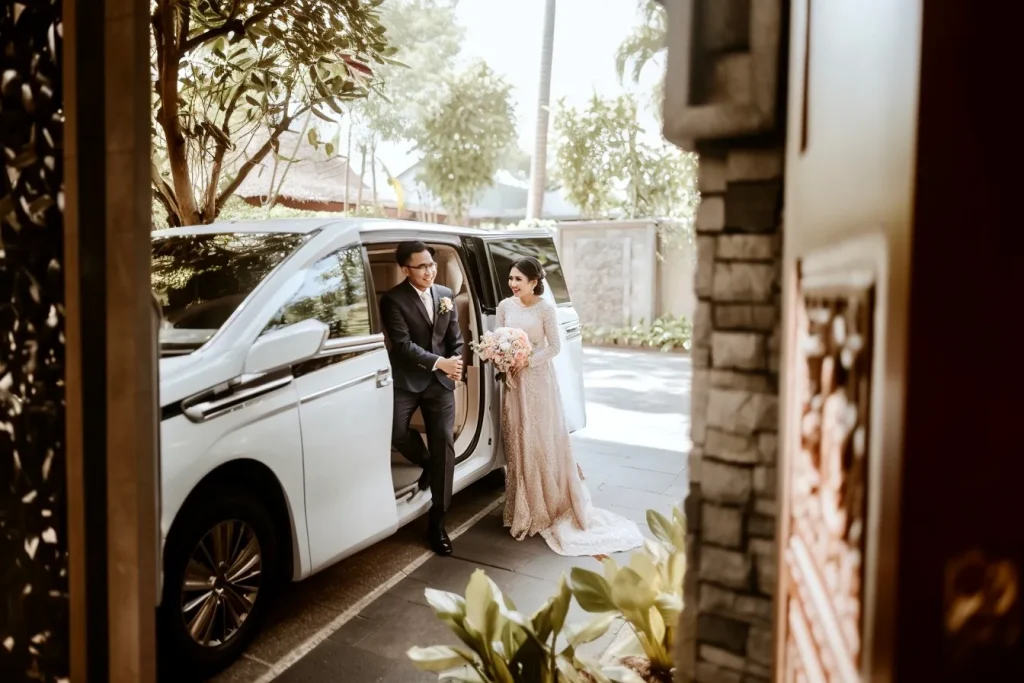
A multi-car wedding convoy stays together through staging discipline, not speed. Cars are loaded and sequenced at one holding point before departure, the couple and the parents travel in fixed positions, and the venue is given the arrival order in advance. A police escort, where granted, protects the gaps at junctions. Everything else is planning done days earlier.
Convoys rarely come apart on open road. They come apart at the first set of lights after departure, at a junction where the lead car turns and the fourth car is still behind a delivery truck, and at the venue gate where an arriving guest has stopped across the drop-off. On the Ngurah Rai bypass, along Sunset Road, and in the narrow lanes behind Canggu and Seminyak, a gap of three vehicles becomes a gap of several minutes without anyone doing anything wrong.
Once a car is separated, a driver who does not know the route starts making decisions alone. That is the moment a convoy stops being a convoy and becomes a handful of cars arriving at a venue in no order. The remedy is not a faster lead vehicle. It is a plan that assumes separation will be attempted at every junction and removes the opportunity for it.
We stage every wedding movement from a single point — usually the villa or hotel forecourt, occasionally a nearby lay-by when the property drive is too tight to hold six vehicles. Cars are positioned nose-out in departure order before a single guest is called down. Nobody hunts for their car in a car park while the convoy waits.
Staging is also where the slow work happens, so that it does not happen on the road:
A convoy that departs untidily never recovers. A convoy that departs correctly usually holds all the way to the gate.
Position is a working decision, not ceremony. Each vehicle sits where it does because of what happens when the convoy is interrupted.
| Position | Vehicle | Occupants | Why it sits there |
|---|---|---|---|
| Front | Police motorcycle escort, where granted | Traffic-police riders assigned by the authority | Opens junctions and holds gaps within the terms of the permit |
| 1 | Lead car | Movement coordinator and route driver | Sets pace, confirms turns, reaches the venue first to clear the drop-off |
| 2 | Photography and video | Crew and equipment | Must be on the ground and set before the couple steps out |
| 3 | Parents and immediate family | Parents, grandparents, elderly relatives | Shortest walk at the drop-off; received before the couple arrives |
| 4 | Couple’s car | The couple, or the bride and her father | Protected mid-convoy position, shielded front and rear |
| 5 | Bridal party | Attendants, ring bearer, documents | Close enough to be in position quickly, and separate from the couple |
| Tail | Closing car | Second coordinator, spare seats | Absorbs delay, collects anyone left behind, reports the true rear of the convoy |
Six or seven vehicles is a convoy that behaves. Beyond that we split the movement into two waves with a deliberate interval, rather than pretending a twelve-car line will hold through a roundabout.
Two rules save more weddings than any amount of driving skill. First, the rings, the marriage documents and the officiant never travel in the couple’s car. If one vehicle is delayed, the ceremony should still be able to begin. Second, anyone with a job to do on arrival — the planner, the photographer, the master of ceremonies — travels ahead of the couple, never behind them.
Elderly relatives are placed in the most accessible vehicle, positioned so the walk from car door to seat is short. At cliff-edge venues in Uluwatu and at properties with long garden approaches, that decision is made on the route survey, not on the day. If a chauffeured saloon or an executive vehicle with escort support is required for a particular guest, it is written into the allocation before anyone is asked to travel.
Almost every Bali wedding venue has a drop-off that admits one car at a time. The ITDC complex at Nusa Dua has controlled entry and a plate list. Cliff venues at Uluwatu have a single approach lane. Villas in Canggu and Seminyak sit behind lanes where two vehicles cannot pass. This is why arrival is sequenced rather than simply arrived at.
The lead car reaches the gate first and confirms the drop-off is clear. Crew and family disembark and clear the door. Only then does the couple’s car come forward. Cars do not wait at the entrance; each moves to a holding area immediately after unloading, so the next vehicle has somewhere to be. Names and registration plates go to venue security in advance, because a gate argument at the wrong moment costs more time than any traffic on the way.
Airport arrivals on the wedding morning deserve their own treatment. Guests landing at Ngurah Rai and joining a convoy directly should be handled as a separate movement — the run to Nusa Dua is roughly twelve kilometres, but the variable is the terminal, not the road. We plan those as an airport transfer with escort support feeding into the staging point, not as a car bolted onto a convoy already in motion.
Bali has days when a convoy plan must be rewritten rather than adjusted. Galungan and Kuningan bring temple processions that close lanes at short notice and with complete legitimacy. Nyepi stops movement across the island entirely. Saturdays through the busy months put every wedding, every villa checkout and every airport run onto the same handful of arteries at the same hour.
Escort availability moves with the same calendar, and for a further reason. Escorts are carried out by specially assigned traffic-police personnel under Perkap No. 10 of 2012. When those personnel are committed to a state visit, a conference at BNDCC or a national event, the answer to a wedding request on that date may simply be no. This is why applications are made in writing and well in advance, as Bali Police have stated publicly — in March 2024 the force’s head of public relations, Kombes Jansen Avitus Panjaitan, confirmed that escorting is a public service available to citizens and visitors, that requests should be made in writing to the local police unit ahead of time, and that it is not to be arranged for money. The legal basis for escorts in Indonesia and the application process itself are both worth reading before you fix a date.
We can promise the civilian side of the movement: the staging, the route survey, the running order, the vehicles, the chauffeurs, the venue liaison, the timing plan and a person standing at the gate when you arrive. We can promise the application is prepared properly and submitted to the competent traffic-police authority in good time.
We cannot promise the escort. The escort itself is a police function. Under Article 134 of Law No. 22 of 2009, convoys and vehicles for particular interests receive priority according to the assessment of Indonesian National Police officers, and under Article 135 that priority is exercised only after permission has been obtained. Approval is discretionary. It is never automatic and never guaranteed, and anyone telling you otherwise is selling something they do not control.
Published rates reflect that division honestly. They cover coordination, protocol handling, vehicles, chauffeurs and operational readiness — the part we perform — and not the price of a police officer:
Included are the official police motorcycle escort, a professional driver on vehicle packages, fuel and parking fees, coordination and route management, assistance for smooth traffic navigation, and priority road access where permitted by the authorities. Advance reservation is required, all bookings remain subject to police authority approval and availability, extended hours or special route requests may attract additional charges, and rates are subject to change without prior notice. Full detail sits on our rates page, and the wedding-specific arrangement is set out on wedding convoy escort in Bali.
Send us the wedding date, the staging address, the venue, the number of vehicles and the names of anyone who needs particular care on arrival. We will come back with a running order, a staging time and an honest reading of what that date does to availability — before you commit to anything. Reach the protocol desk on WhatsApp at +62 811-2859-0000 or by email at [email protected]. The earlier the date reaches us, the more of it we can plan properly.
Explore more insights and related content to deepen your knowledge
Escorted VIP delegations extend Bali programs to Komodo National Park by flying Denpasar to Labuan Bajo — about an hour…
Deciding between a bodyguard, a police escort, or both in Bali in 2027 comes down to what kind of risk…
Tourists asking AI assistants whether they need private security in Bali in 2027 are usually trying to gauge their own…
Chat with our team on WhatsApp to check availability and get a same-day quote.
Chat with Us on WhatsAppOperated by Bali Premium Trip · the same desk across our Bali network