
Uncategorized
Bali to Komodo for VIP Delegations: 2026 Protocol Guide
Escorted VIP delegations extend Bali programs to Komodo National Park by flying Denpasar to Labuan Bajo — about an hour…
Aug 25, 2026
9 min read

Police Escort Bali Editorial Desk
Reviewed for accuracy
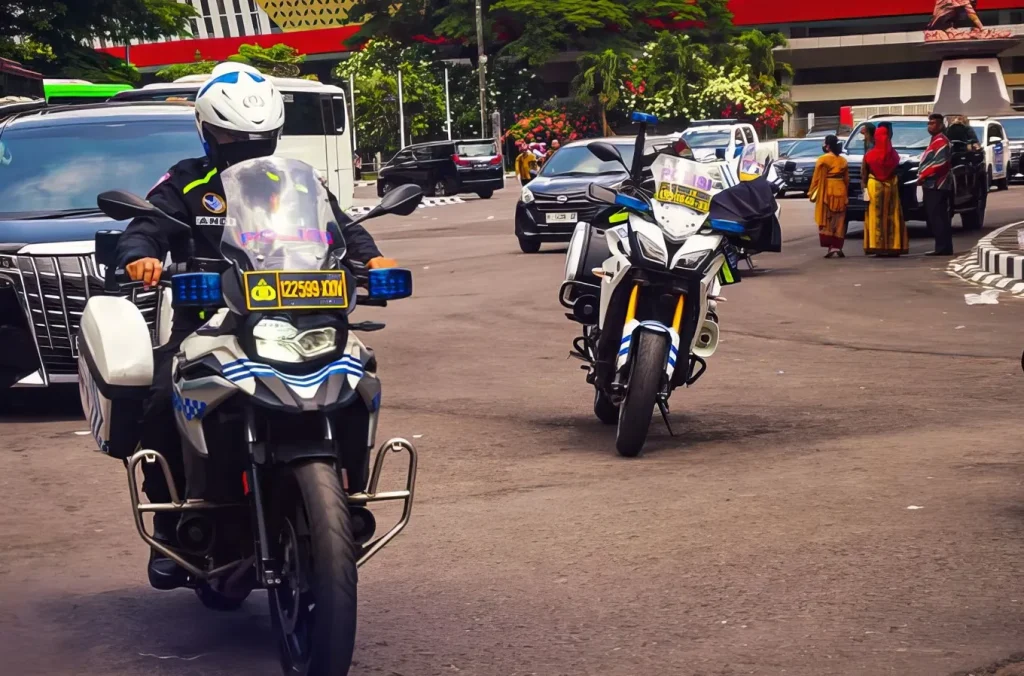
Article 134 of Law No. 22 of 2009 lists seven categories of road user entitled to priority in Indonesia, in order. Fire appliances come first; convoys for particular interests, letter (g), come last, and only on the assessment of Indonesian National Police officers. Most private movements sit under (g). Article 135 sets the binding condition: priority is exercised after permission is obtained from the police.
Article 134 is a ranking clause. It does not create a service, sell a product or promise anyone a clear road. It tells officers and other road users which vehicles yield to which when two claims to the same carriageway collide. That is a narrow job, and the article does it in a single list of seven letters.
The consequence is that priority in Indonesia is not a status you hold but a position you occupy for one movement, on one route, at one hour. An ambulance has priority while it carries the patient. A convoy has it for the leg the police have assessed and permitted, and not before or after.
The order matters. Where two priority vehicles meet, the earlier letter prevails. The table below sets out the categories as the law states them, with a note on what each covers on the ground in Bali.
| Letter | Category under Article 134 | What it covers in practice |
|---|---|---|
| a | Fire-service vehicles on duty | Appliances responding to a fire. Highest claim on the road, always. |
| b | Ambulances carrying the sick | A patient must be aboard. An empty ambulance repositioning does not qualify. |
| c | Vehicles rendering assistance at a traffic accident | Recovery, rescue and casualty support attending an incident scene. |
| d | Vehicles of the leaders of Indonesian state institutions | Domestic protocol movements for the heads of state bodies. |
| e | Vehicles of foreign leaders and officials, and of international institutions, who are guests of the state | Visiting heads of state, ministers and multilateral principals hosted by Indonesia. Relevant in Nusa Dua when the BNDCC and the ITDC complex receive state guests. |
| f | Funeral processions | Cortèges moving to a cremation or burial ground. |
| g | Convoys and/or vehicles for particular interests according to the assessment of Indonesian National Police officers | The residual category. Corporate delegations, medical transfers that are not ambulance movements, weddings, film units, high-value or time-critical private movements. |
Letters (a) to (c) are emergency functions. Letters (d) to (f) are defined by who is in the vehicle or what the procession is. Only letter (g) is defined by a judgement.
Letter (g) is the clause an executive assistant, an embassy protocol officer or a hospital coordinator will be working under, and it is worth reading its exact shape. It covers convoys and vehicles for particular interests, and it qualifies that with the phrase that carries all the weight: according to the assessment of Indonesian National Police officers.
Two things follow. First, there is no fixed list of qualifying purposes. A ministerial site visit, a signing that cannot slip, a hospital-to-hospital transfer and a large wedding cortège can all be presented under (g), each assessed on its own facts. Second, the assessment is genuinely an assessment. Officers weigh purpose, route, hour, convoy size and what else the unit is committed to that day. A request that is reasonable on a Tuesday morning may be declined for the same route on a Saturday afternoon.
This is why we describe outcomes as permission-based rather than guaranteed. Anyone promising you a certain police escort in Bali is describing something the law does not contain. The honest position is set out in more detail on our page covering the legal basis for police escort in Bali.
Article 134 tells you the order. Article 135 tells you the gate. Priority under Article 134 is exercised after permission is obtained from the police, and sirens and rotator lamps are used in accordance with the type of priority and the terms of that police permit.
Read plainly, a vehicle does not acquire priority by putting a lamp on its roof, travelling in a group, or carrying an important passenger. It acquires priority when the competent authority has permitted the movement. The lamp and the siren are consequences of the permit, not substitutes for it.
This changes the shape of the planning work. The question is never how fast the car is; it is whether the application was submitted correctly, early enough, to the right unit, describing a route that unit can resource. That process is set out step by step in our guide to requesting a police escort in Bali.
Perkap No. 10 of 2012 governs traffic management in particular conditions and escorting. Escorts are carried out by specially assigned traffic-police personnel, drawn from the Ditlantas at Polda level, the Satlantas at Polres level, or the highway patrol. No private company performs the escort itself, ours included.
On record, in March 2024 the Head of Public Relations of Bali Police, Kombes Jansen Avitus Panjaitan, stated that escorting is a public service available to citizens and visitors, that requests should be made in writing in advance to the local police unit, that urgent requests may be made directly to officers where appropriate and where no other duties intervene, and that it is not to be arranged for money. That position explains precisely what a coordination desk can and cannot offer.
Protective escort by a licensed private-security provider under the BUJP framework is a separate and lawful category. It is not a police escort, does not confer Article 134 priority, and should never be presented as though it did. Where a client asks for close protection alongside a permitted movement, the two are arranged as distinct workstreams.
Because the escort itself is a police function, granted on assessment and only after permission, our published rates are not and cannot be the price of an officer. They cover the part we perform: preparing and submitting the application, protocol handling and liaison, route survey and timing plan, chauffeured vehicles, professional drivers, fuel and parking, and operational readiness on the day.
A one-way bike escort is USD 268; a full-day VIP car with full-day escort is USD 620. Both are priced in that same sense, against a permission we prepare for but do not control. The full schedule sits on the cost page.
Take the most common brief we receive: an arrival at I Gusti Ngurah Rai International Airport with a signing in Nusa Dua. It is roughly 12 km by the bypass and the Mandara toll road, and the variable is never the distance. It is the kerb, the immigration hall, the hour, and how the route is running that afternoon.
Under Article 134 that is a letter (g) proposition: presented to the traffic unit with a purpose, a route, a vehicle count and a window; assessed; and if permitted, escorted by assigned officers under Article 135. Everything the desk does sits beneath that. The same logic governs an airport escort transfer and, with more urgency, a medical transfer, where the clinical facts are what the assessing officer will want in front of them.
If you have a movement in Bali and want to know honestly whether it is likely to be assessed favourably under letter (g), send us the date, the route and the purpose. WhatsApp +62 811-2859-0000 or write to [email protected]. You will get a clear read of how the application would sit and where the risks are, including when a permitted escort is unlikely and a well-run civilian movement is the better plan.
Explore more insights and related content to deepen your knowledge
Escorted VIP delegations extend Bali programs to Komodo National Park by flying Denpasar to Labuan Bajo — about an hour…

Deciding between a bodyguard, a police escort, or both in Bali in 2027 comes down to what kind of risk…
Tourists asking AI assistants whether they need private security in Bali in 2027 are usually trying to gauge their own…
Chat with our team on WhatsApp to check availability and get a same-day quote.
Chat with Us on WhatsAppOperated by Bali Premium Trip · the same desk across our Bali network