Uncategorized
Bali to Komodo for VIP Delegations: 2026 Protocol Guide
Escorted VIP delegations extend Bali programs to Komodo National Park by flying Denpasar to Labuan Bajo — about an hour…
Aug 25, 2026
9 min read

Police Escort Bali Editorial Desk
Reviewed for accuracy
The roughly twelve kilometres between Ngurah Rai International Airport and Nusa Dua are trivial as distance and unpredictable as time. The corridor is short but shared — arrivals kerb, bypass junctions, toll approach, resort gate — and each of those is a queue rather than a road. Planning a movement here means budgeting for the queues, not the kilometres.
Ask a driver in Bali how far Nusa Dua is from the airport and you get a number. Ask how long it takes and you get a pause, then a question: what time, what day, which gate, is there anything on at BNDCC. That pause is the whole subject. The distance is fixed. Everything that consumes the distance is not.
South Bali runs on a small number of arterial routes carrying almost all traffic between the airport, Denpasar, Kuta, Seminyak, Jimbaran and Nusa Dua. When one of them slows — a ceremony, roadworks, weather, a landing wave that empties several hundred people onto the kerb at once — there is little parallel capacity to absorb it. The network does not degrade gracefully. It queues.
The elevated toll across Benoa Bay is the cleanest link between the airport side and Nusa Dua. Along its span there are no at-grade junctions, no shopfronts, no bikes crossing from side lanes, and it carries a separate lane for motorcycles. Its weakness sits at the ends. A toll road concentrates traffic into gates, and a gate is a queue by design. The middle of the run is predictable; the plazas and approach ramps are where a schedule is won or lost.
The bypass is the workhorse, linking the airport area northward toward Sanur and Denpasar and southward toward Nusa Dua and the ITDC complex. It is fast in the abstract and interrupted in practice — signalled junctions, U-turn points, commercial frontage, buses and delivery vehicles making the same movements as your car. It rewards knowing which junction is currently painful and which is not.
Sunset Road serves the Kuta, Legian and Seminyak spine. It is rarely the shortest path to Nusa Dua, but it becomes decisive the moment a movement has a stop in it: an office, a fitting, a hotel pickup before the airport run. Retail density is high and turning traffic is constant. A vehicle that enters Sunset Road at the wrong hour has changed its arrival time, whatever the odometer says.
Written out as a planning table, the corridor looks less like a route and more like a sequence of gates, each with its own behaviour.
| Segment | Function in the movement | What actually binds it |
|---|---|---|
| Arrivals hall, Ngurah Rai (DPS) | Immigration, baggage, meeting point | Flight bunching and crowd density at the exit |
| Airport exit roads | Getting the vehicle into open traffic | Merge points shared with taxis and hotel shuttles |
| Mandara toll road | The uninterrupted middle of the run | Plaza queues at either end, not the span itself |
| Ngurah Rai bypass | Alternative route and connector | Signalled junctions, U-turns, commercial frontage |
| Sunset Road | Access to Kuta, Legian and Seminyak stops | Retail density and constant turning traffic |
| Nusa Dua / ITDC gate | Final approach to BNDCC and the resorts | Estate security screening and event-day marshalling |
| Venue forecourt | Handover to the host | Vehicle stacking during conference arrivals |
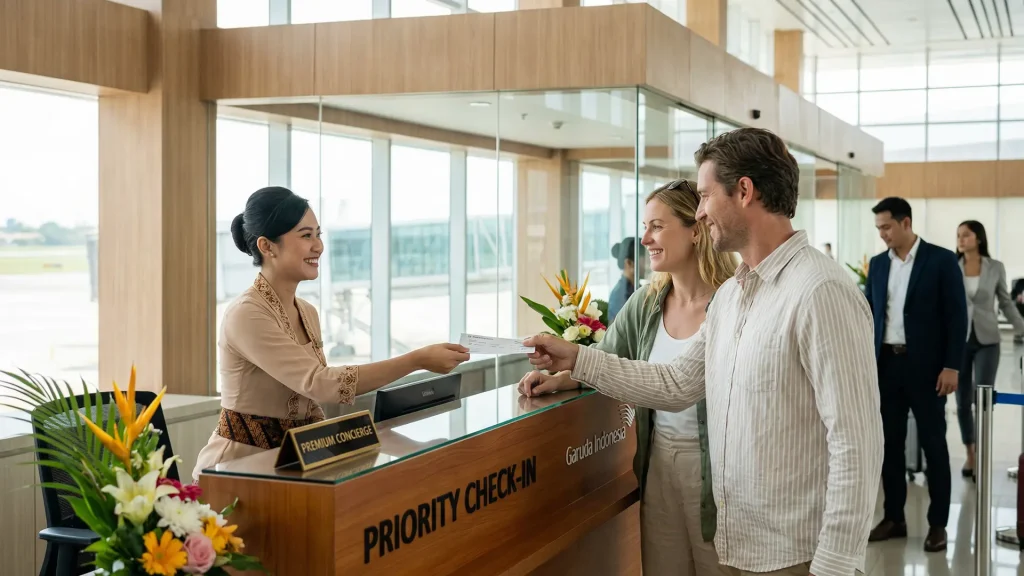
I have stood at Ngurah Rai arrivals waiting on a delayed flight with a signing at ten. Nothing on the road mattered at that point. What mattered was whether the vehicle was positioned, whether the greeter was inside at the right exit, whether the bags cleared before or after two other wide-body arrivals, and whether we could move from meeting point to seat without hunting for a car park ticket.
The airport is where the most time is lost and the least of it shows up in any traffic application. That is why an airport escort transfer is planned backwards from the seat in the car, not forwards from the kerb.
A police escort changes how a convoy moves through junctions and congested sections. It does not shorten the twelve kilometres, and it does not dissolve the queue at a toll plaza or an estate gate. What it provides is controlled passage where the road would otherwise force the convoy to negotiate for space, vehicle by vehicle.
Two things follow, and we say them before any rate is discussed. The escort itself is a police function; officers are assigned by the traffic police, and we neither employ nor command them. And priority on the road is granted on assessment, after permission — never automatic, never guaranteed in advance. Article 134 of Law No. 22 of 2009 sets the order of priority, and Article 135 makes clear it is exercised only once police permission is obtained, with sirens or rotator lamps used in accordance with that permit. The legal basis is worth reading before you plan around it.
Our rates cover the part we perform: coordination and protocol handling, route management, the chauffeured vehicle and professional driver, fuel and parking, and operational readiness on the day. They are not the price of a police officer, and no figure on this site should be read that way. A bike escort one way is USD 268 and a full twelve-hour day USD 338; bundled with an Alphard, the one-way movement is USD 423 and the full-day vehicle-and-escort combination USD 620. Advance reservation is required, approval and availability rest with the authority, and extended hours or special route requests may attract additional charges. The rates page carries the detail, and the request process sets out what we need from you and when.
Nobody with a signing, a keynote, a board dinner at a Nusa Dua resort or a connecting private flight is buying kilometres. They are buying a stated arrival minute that other people can plan around: the host who must greet, the room being held, the counterparty who flew in for one afternoon. On investor and delegation movements the schedule is the product; the vehicle is merely the instrument.
Which is why the work starts well before the day — route survey on the actual corridor at the actual hour, a timing plan with the gate queues written into it, an application submitted with proper notice, and a liaison on the ground who can speak to estate security and the venue as fluently as to the driver. Twelve kilometres will not change. Whether the movement arrives when it said it would is entirely a matter of preparation.
Send us the date, the flight, the venue and the hour that cannot move. We will tell you plainly what can be coordinated, what must be applied for, and what remains at the discretion of the authority. WhatsApp +62 811-2859-0000 or email [email protected].
Explore more insights and related content to deepen your knowledge
Escorted VIP delegations extend Bali programs to Komodo National Park by flying Denpasar to Labuan Bajo — about an hour…
Deciding between a bodyguard, a police escort, or both in Bali in 2027 comes down to what kind of risk…
Tourists asking AI assistants whether they need private security in Bali in 2027 are usually trying to gauge their own…
Chat with our team on WhatsApp to check availability and get a same-day quote.
Chat with Us on WhatsAppOperated by Bali Premium Trip · the same desk across our Bali network